Finding a capable synthesizer on a modest budget is easier than ever, but the options vary widely. Some prioritize hands-on analog sound shaping, while others focus on portability, sequencing, MIDI control, or experimental play.
This roundup compares 10 budget-friendly instruments for beginners, producers, performers, and curious sound designers. Use the guide below to match features, workflow, and limitations with the way you plan to make music.
Best 10 Synthesizers Under 300 Picks for 2026
Best Acid-Bass Pick

- Fully analog acid-bass signal path
- 128 patterns with Song Mode
- Haptic pads, arpeggiator, and MIDI
Best For: Hands-on electronic bass sequencing and live pattern performance
Best Pocket Retro Pick

- Iconic analog sound and stylus control
- Three octaves with optional vibrato
- Battery-powered with speaker and headphone output
Best For: Portable retro play, collecting, and beginner experimentation
Best Analog Sound-Design Pick

- Dual VCOs for thick analog tones
- Four mixable oscillator waveforms
- Duophonic and paraphonic operation
Best For: Analog sound design and layered oscillator performance
Best Learning Project
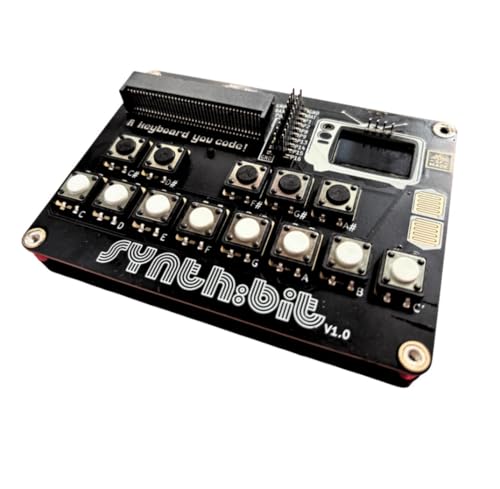
- 16-input keyboard for Micro:bit projects
- OLED display and portable battery pack
- Expandable with jumper pins and custom builds
Best For: Beginner coding, electronics, and educational music projects
Compact Sound Design

- Compact 9.21-inch design
- Alloy-steel body
- MIDI connectivity
Best For: Portable MIDI setups and compact sound design
Pocket Analog Creativity

- Cassette-sized analog synth
- 13-key monophonic touchpad
- Conductive-object experiments
Best For: Beginners, students, and portable musical exploration
Gesture-Controlled Exploration

- Touchless gesture control
- Over 70 selectable voices
- Color display with pitch guidance
Best For: Beginners seeking an interactive theremin-style instrument
Best Analog Effects Pick

- Analog space delay and filter
- Ribbon controller with pitch LFO
- Battery-powered built-in speaker
Best For: Portable analog sound design and experimental textures
Best MIDI Control Center
37-Key MIDI Keyboard Controller

- Velocity-sensitive keyboard for expressive playing
- Eight pads and eight assignable knobs
- Bluetooth and USB connectivity
Best For: DAW-based production, beat making, and portable control
Best Compact Poly Synth

- Three-voice analog polyphony
- 27 touch-sensitive keys
- 16-step sequencer with sync I/O
Best For: Compact analog playing and sequenced patterns
Best Acid-Bass Pick – Donner Essential B1
If you want one of the more performance-focused synthesizers under 300, the Donner Essential B1 combines a fully analog signal path with an approachable step sequencer. Its 128-pattern memory, haptic pads, arpeggiator, saturation, and delay make it a practical choice for building classic acid-style basslines.
Best For: Electronic musicians who want hands-on bass sequencing, live pattern performance, and classic analog acid sounds.
Pros:
- Fully analog 1 VCO, 1 VCF, and 1 VCA signal path
- 128-pattern memory plus Song Mode for chaining patterns
- Haptic performance pads and an 8-mode arpeggiator
- USB-C, dual 5-pin MIDI, and Sync connectivity
Cons:
- Focused on bass-synth sounds rather than broad polyphonic synthesis
- Its feature set may still require learning despite the intuitive sequencer
The Essential B1 is a strong fit when sequencing and tactile performance matter more than a large keyboard. Built-in saturation and delay also help shape a finished sound without requiring external effects.
Best Pocket Retro Pick – Stylophone Original
The Stylophone Original is one of the simplest synthesizers under 300 for portable, casual playing. Its stylus-controlled metal surface produces a distinctive analog tone across three octaves, while the built-in speaker and battery operation make it easy to use away from a studio.
Best For: Beginners, collectors, and musicians who want an inexpensive pocket instrument with a recognizable retro sound.
Pros:
- Compact design measures less than 12 cm wide
- Stylus interface is easy to play and immediately distinctive
- Three octaves with optional vibrato
- Built-in speaker, headphone socket, and auxiliary connectivity
Cons:
- Its compact touch-surface design is less versatile than a conventional keyboard
- Requires three AA batteries
This is a character instrument rather than a full production synthesizer. Choose it for quick musical sketches, retro effects, or a beginner-friendly introduction to electronic sound.
Best Analog Sound-Design Pick – Behringer CAT
For shoppers comparing synthesizers under 300, the Behringer CAT stands out for its dual-VCO analog architecture and paraphonic operation. It offers four simultaneous oscillator shapes, a pure analog signal path, and the ability to control both oscillators independently for thicker, more flexible tones.
Best For: Sound designers and electronic musicians who prioritize fat analog tones, oscillator layering, and duophonic or paraphonic playing.
Pros:
- Dual VCO design for large, layered analog sounds
- Pure analog VCO, VCF, and VCA signal path
- Four mixable waveforms, including sub-octave square
- Duophonic/paraphonic mode independently controls both oscillators
Cons:
- Paraphonic operation is not the same as full polyphony
- The notes do not identify a built-in keyboard or sequencer
The CAT is best viewed as a tone-shaping instrument for players who want oscillator depth and authentic analog behavior. Its external signal-processing and Eurorack-oriented design also make it appealing in a broader hardware setup.
Best Learning Project – Synth:bit Micro:bit Module
The Synth:bit is a project-oriented alternative among synthesizers under 300, turning a compatible Micro:bit into a 16-input keyboard module. With an OLED display, battery pack, audio jack, jumper-pin expansion, and support for MakeCode and Python workflows, it is designed for experimentation rather than conventional studio production.
Best For: Beginners and children learning coding, electronics, and digital music through hands-on Micro:bit projects.
Pros:
- 16-input 4×4 matrix provides a full-octave keyboard layout
- OLED display gives visual feedback for settings and parameters
- Battery pack and 3.5mm audio jack support portable use
- LEGO-compatible base and jumper pins encourage custom builds
Cons:
- Micro:bit is required and not included
- Its capabilities depend on programming and the connected Micro:bit
- It is geared toward learning and experimentation rather than turnkey synthesis
The Synth:bit makes the most sense when the goal is to build and understand a musical device. Online lessons, sample code, and expansion connections give learners room to move from simple keyboard projects to custom controllers.
Compact Sound Design – PHARA-O MINI
For shoppers comparing synthesizers under 300, the Behringer PHARA-O MINI is a compact option focused on portable sound design. Its alloy-steel body measures 9.21 by 6.1 by 2.56 inches, weighs 0.65 kg, and includes MIDI connectivity.
Best For: Musicians who want a small, durable-looking synthesizer for compact setups and MIDI-based use.
Pros:
- Compact dimensions suit space-conscious setups.
- Alloy-steel body and glossy black finish.
- MIDI connector supports compatible equipment.
Cons:
- The supplied notes do not specify its voices, controls, or sequencing features.
- Its 0.65 kg weight may be more than some ultra-light portable options.
The PHARA-O MINI makes the most sense when physical compactness, MIDI connectivity, and a sturdy alloy-steel construction matter more than detailed feature comparisons.
Pocket Analog Creativity – Synth-a-Sette
Among synthesizers under 300, the MicroKits Synth-a-Sette stands out as a tiny, beginner-friendly analog instrument. It has a 13-key monophonic touchpad, built-in speaker, line out, batteries, and a USB-C connector in a cassette-sized plastic body.
Best For: Beginners, students, and musicians seeking a highly portable synth for experimentation and simple melodies.
Pros:
- Extremely compact 4 by 2.6 by 0.5-inch design.
- Includes octave-up control, optional vibrato, speaker, and line out.
- Alligator clips enable conductive-object experiments such as a fruit-based keyboard.
- Includes a music sheet and a two-year manufacturer warranty.
Cons:
- The 13-key touchpad is monophonic rather than polyphonic.
- Its plastic body may feel less substantial than metal-bodied instruments.
- The simplified design may be limiting for advanced synthesis work.
The Synth-a-Sette is more of a playful learning tool and portable melody maker than a full studio centerpiece, making its unusual conductive-input feature a major part of its appeal.
Gesture-Controlled Exploration – Mini Theremin
For buyers exploring synthesizers under 300 with a different playing style, this mini theremin uses hand gestures instead of a conventional keyboard. It includes a detachable antenna, built-in speaker, color display, Type-C power, and more than 70 selectable voices.
Best For: Beginners and music lovers who want an accessible, touchless instrument with visual learning aids.
Pros:
- Gesture-controlled playing offers an unusual performance experience.
- Provides over 70 voices, including more than 20 traditional instrument sounds.
- Color display shows waveform, frequency, and volume.
- Pitch indicator and piano display support note practice.
Cons:
- The supplied notes do not describe advanced synthesis or recording functions.
- The 20 by 11 by 3 cm size is portable but larger than pocket-sized synths.
- Automatic headphone switch-off may limit use of the built-in speaker while headphones are connected.
This mini theremin is a strong choice for visual, hands-on exploration rather than traditional keyboard playing, especially for beginners who value tone variety and pitch guidance.
Best Analog Effects Pick – Korg Monotron Delay
The Korg Monotron Delay is a compact choice for shoppers seeking synthesizers under 300 with a distinctly hands-on analog character. Its ribbon keyboard, analog filter, pitch LFO, and space delay make it suited to experimenting with drones, textures, and echo-heavy sounds.
Best For: Portable analog sound design, experimental effects, and beginners who want a simple ribbon-controlled instrument.
Pros:
- Analog-style space delay with adjustable rate and intensity
- Wide-range ribbon controller keyboard
- Classic MS-10 and MS-20-inspired analog filter
- Built-in speaker and battery power for portable use
Cons:
- Ribbon controller may feel less familiar than conventional keys
- Limited control set compared with larger synthesizers
The Monotron Delay is most appealing when portability and character matter more than a full keyboard or extensive sequencing features. It is a focused sound-design tool with useful built-in effects.
Best MIDI Control Center – 37-Key MIDI Keyboard Controller
For shoppers comparing synthesizers under 300, this portable MIDI keyboard controller emphasizes DAW control and flexible music production rather than a standalone sound engine. It combines velocity-sensitive keys with drum pads, knobs, an OLED display, Bluetooth, and USB connectivity.
Best For: Home studios, beat making, recording, and producers who need portable control for a computer, tablet, or smartphone.
Pros:
- Velocity-sensitive keys for expressive performance
- Eight assignable pads and eight knobs for hands-on control
- Bluetooth and USB connectivity
- OLED display provides feedback on settings and performance data
Cons:
- Requires compatible external software or devices for sound generation
- Supplied details conflict on the key count, listing both 37-key and 49-key specifications
- No warranty is listed
This controller is a practical option for software-based production, especially if pads and assignable knobs are important. Verify the key count before buying because the supplied specifications are inconsistent.
Best Compact Poly Synth – Behringer JT Mini
The Behringer JT Mini is a strong candidate among synthesizers under 300 for buyers who want compact analog hardware with polyphonic capability. Its three-voice architecture, touch-sensitive keys, state-variable filter, sequencer, and sync connections support both playing and pattern-based experimentation.
Best For: Compact analog performance, short sequencer patterns, and musicians seeking three-voice polyphony in a small instrument.
Pros:
- Three-voice analog polyphony
- Twenty-seven touch-sensitive keys
- State-variable VCF for tonal shaping
- Built-in 16-step sequencer and 3.5mm sync I/O
Cons:
- Compact 27-key layout may be limiting for broader performances
- Plastic construction
- Auxiliary connectivity may require adapters for some setups
The JT Mini balances portability with more traditional synthesizer features than a basic effects-focused instrument. Its three-voice design and sequencer make it particularly useful for compact setups and analog pattern work.
How We Picked the Best Synthesizers Under 300
We focused on instruments that offer meaningful sound creation or control at an accessible price. The selection includes analog synthesizers, compact keyboard instruments, pocket synths, experimental controllers, and MIDI-focused options. We considered each product’s synthesis approach, playability, connectivity, portability, built-in effects or sequencing, and suitability for beginners.
Because these products serve different purposes, “best” depends on your workflow. A small analog synth may be ideal for basslines and leads, while a MIDI keyboard controller may be better for software instruments and complete music-production setups.
Quick Comparison
| Type | Best For | What to Look For |
|---|---|---|
| Analog synthesizer | Hands-on sound design | Oscillators, filters, patching, and effects |
| Sequencer synth | Pattern-based production | Pattern memory, tempo control, and sequencing workflow |
| Pocket or novelty synth | Travel and experimentation | Battery operation, built-in speaker, and compact controls |
| MIDI controller | Computer-based production | Key count, pads, knobs, USB support, and software compatibility |
| DIY or educational module | Learning and tinkering | Programmability, display, expansion pins, and construction |
Key Buying Factors for Synthesizers Under 300
Sound Engine and Polyphony
Analog oscillators can provide immediate, tactile sound shaping, but many affordable models are monophonic or paraphonic. If you want chords, verify the voice count and understand whether notes share filters or envelopes. For basslines and leads, monophonic designs can be an advantage rather than a drawback.
Controls and Playability
Look for controls that match your style. Knobs, sliders, ribbon strips, touch surfaces, and patch points encourage experimentation, while a conventional keyboard is more familiar for melodic playing. A compact layout saves space but may feel limiting for two-handed performance.
Connectivity
Check whether the instrument supports USB, MIDI, audio input, headphones, or external effects. MIDI controllers generally need a computer or hardware sound source, whereas standalone synths can create sound independently. Also confirm power requirements if you plan to perform or travel.
Portability and Learning Curve
Small synths are easy to carry, but compact controls can be less precise. Beginners may prefer clear signal paths, accessible presets, or pattern memory. More experimental products can be rewarding for learning synthesis, though they may require additional gear or patience.
Who Should Buy Which Synthesizers Under 300?
- Beginners: Choose a straightforward keyboard-style or compact standalone synth with clearly labeled controls and an easy workflow.
- Beatmakers: Prioritize sequencing, pattern storage, effects, and reliable synchronization.
- Analog enthusiasts: Look for dedicated oscillators, filters, modulation controls, and hands-on patching.
- Computer producers: A MIDI controller with keys, pads, knobs, and USB connectivity may offer more value than a standalone sound engine.
- Traveling musicians: Pocket-sized, battery-powered instruments are convenient for sketches and experimentation.
- Students and makers: Educational modules with displays, programmable controls, or expansion connections can make synthesis more interactive.
Before buying, decide whether you need an instrument that makes sound on its own or a controller for existing software. That single distinction can narrow the field quickly and help you get more practical value from your budget.