Finding the right synthesizer under $1,000 means balancing sound engine, keyboard feel, sequencing, connectivity, and workflow. This roundup covers compact instruments, analog monosynths, polyphonic keyboards, and flexible production-focused options.
Whether you are building a first hardware setup or adding a distinctive voice to an established studio, these picks offer practical ways to create basses, leads, pads, textures, and complete sequences without exceeding the budget.
Best 10 Synthesizers Under 1000 Picks for 2026
Best Experimental Pick
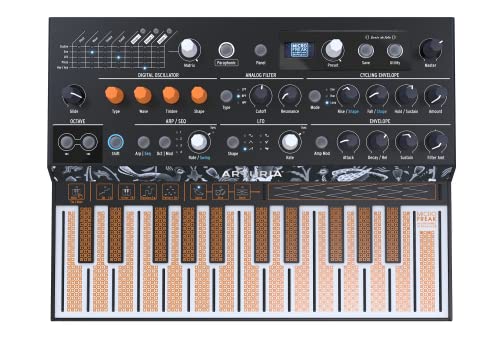
- Hybrid digital oscillator and analog-filter design
- 25-key keyboard with individual-note aftertouch
- CV, USB, MIDI, and flexible sequencing
Best For: Advanced players and experimental sound designers
Best Portable Groovebox

- Compact micro polysynth inspired by the SH-101
- Onboard sequencing and wave manipulation
- Lightweight hands-on design for mobile setups
Best For: Portable jamming, basses, leads, and beginner-friendly exploration
Best Analog Polyphonic Value

- Four VCOs with warm, bass-heavy analog tones
- Mono, unison, polyphonic, and paraphonic modes
- 37 full-size keys plus sequencer and arpeggiator
Best For: Studio players wanting full-size keys and analog character
Best Production Workstation

- Motif sound engine with layered and zoned voices
- 128-note polyphony for live and sequence playback
- USB audio/MIDI with 16-channel MIDI support
Best For: Producers and performers building layered DAW-based arrangements
Flagship Analog Power

- Two wavefolding VCOs, sub-oscillator, and flexible ladder filter
- 32 full-size velocity- and aftertouch-sensitive keys
- 64-step sequencer, CV, MIDI, and USB-C connectivity
Best For: Hands-on monophonic analog performance and sound design
Ultra-Compact Pick

- Compact 9.21 x 6.1 x 2.56-inch design
- Lightweight 0.65 kg body
- Alloy-steel construction with MIDI connectivity
Best For: Space-conscious and portable MIDI setups
Versatile Performance Choice

- Up to 18 voices with analog modeling and onboard effects
- Built-in vocoder, microphone, and VocalTune processing
- 256 presets, Animate controls, and real-time arpeggiator
Best For: Compact polyphonic performance and vocal-focused sound design
Portable Sound Lab

- Battery-powered with built-in speaker
- LFO, filter, PWM, and analogue delay
- CV/Gate outputs for hardware rigs
Best For: Portable sound design and expressive hardware performance
Polyphonic Analog Workstation

- Eight-voice analog polyphony
- Two VCOs per voice
- 400 program memories plus arpeggiator and sequencer
Best For: Analog chords, unison leads, and studio sound programming
Acid Bass Sequencer

- Fully analog one-VCO bass engine
- 128 patterns with Song Mode
- Haptic pads, arpeggiator, saturation, and delay
Best For: Acid basslines and hands-on pattern performance
Best Experimental Pick – Arturia MicroFreak
For musicians seeking synthesizers under 1000 with unusual sound-design potential, the Arturia MicroFreak is a compact hybrid instrument built for experimentation. Its digital oscillator engines, resonant analog filter, touch-sensitive 25-key surface, modulation matrix, and flexible sequencer offer substantial creative range in a portable format.
Best For: Advanced players, experimental sound designers, and producers who need CV, MIDI, USB, and expressive sequencing in a small synthesizer.
Pros:
- Offers 17 oscillator types spanning wavetable, physical-modeling, vocoder, noise, and other sounds.
- 25-key touch-plate keyboard supports individual-note pressure or poly-aftertouch.
- Includes a modulation matrix, automation recording, Spice and Dice sequencing, CV outputs, USB, and MIDI.
Cons:
- The flat touch-plate keyboard may feel unfamiliar compared with conventional keys.
- Its advanced modulation and sequencing features may require a steeper learning curve.
The MicroFreak is a strong choice when distinctive textures and hands-on experimentation matter more than a traditional keyboard experience. Its compact size and broad connectivity also make it useful alongside modular gear or a DAW.
Best Portable Groovebox – Roland AIRA Compact S-1
Roland AIRA Compact S-1 Tweak Synth | Ultra-Portable Micro Polysynth. Advanced Tools
Check Price On AmazonThe Roland AIRA Compact S-1 is a practical option among synthesizers under 1000 for compact, spontaneous music making. Inspired by the SH-101, it combines hands-on controls with basses, leads, wave manipulation, onboard sequencing, and performance features in a lightweight design.
Best For: Beginners, mobile producers, and experienced synth users who want a small instrument for bass lines, leads, sequencing, and creative sound exploration.
Pros:
- Provides a micro polysynth workflow inspired by the Roland SH-101.
- Includes snappy basses, expressive leads, and futuristic wave-manipulation capabilities.
- Combines hands-on controls, onboard sequencing, and performance-oriented features.
Cons:
- The compact format may not suit players who prefer a full-size keyboard.
- The supplied notes do not specify connection options or detailed polyphony information.
With a one-pound body and dimensions of 10.25 by 6.6 by 3.5 inches, the S-1 is particularly appealing for portable setups. It offers an approachable entry point without limiting the instrument to beginner use.
Best Analog Polyphonic Value – Behringer Poly D
The Behringer Poly D stands out among synthesizers under 1000 for its large, analog-focused design and four-voice architecture. It pairs four VCOs and classic ladder-filter circuitry with 37 full-size semi-weighted keys, a sequencer, arpeggiator, chorus, and distortion.
Best For: Players who want warm, bass-heavy analog tones, full-size keys, and flexible mono, unison, paraphonic, or polyphonic operation.
Pros:
- Four VCOs deliver a broad, fat analog sound with warm, rich character.
- Supports mono, unison, and polyphonic/paraphonic modes.
- Includes 37 velocity-sensitive semi-weighted full-size keys, a 32-step sequencer, arpeggiator, stereo chorus, and distortion.
Cons:
- At 26.1 pounds and 31.4 inches wide, it is much less portable than compact synthesizers.
- The supplied notes list mixed connector information without specifying the full connection set.
The Poly D is best suited to a stationary studio or performance setup where substantial analog controls and a familiar keyboard feel are priorities. Its four-voice design adds versatility while retaining a bass-forward analog character.
Best Production Workstation – Yamaha MX49
For buyers comparing synthesizers under 1000 with broader production duties, the Yamaha MX49 combines a Motif sound engine with keyboard performance and computer integration. Its 128-note polyphony, USB audio/MIDI, 16-channel MIDI support, and vintage-effect modeling make it suited to layered arrangements and live or studio work.
Best For: Producers and performers who need a 49-key instrument for layered sounds, sequencing, USB recording, and dependable polyphony.
Pros:
- Provides 128 notes of polyphony for live playing and full 16-track sequences.
- Motif sound engine supports layering, zoning, switching, cycling, randomizing, and controlling up to eight elements in one voice.
- Class-compliant USB records and plays back stereo audio plus 16 channels of MIDI through one cable.
Cons:
- Its 38.6-inch width makes it less compact than micro synthesizers.
- The supplied notes do not detail the key action or onboard sequencing controls.
The MX49 is a practical pick for musicians who value workstation-style sounds and computer connectivity over an experimental synthesis interface. It offers a straightforward bridge between keyboard performance, DAW recording, and multitrack MIDI production.
Flagship Analog Power – Moog Messenger
The Moog Messenger is a strong choice among synthesizers under 1000 for musicians who want hands-on analog sound in a performance-ready format. Its two wavefolding VCOs, sub-oscillator, versatile ladder filter, and full-size expressive keys provide plenty of room for basses, leads, and experimental patches.
Best For: Players and producers seeking a portable, full-size-key monophonic analog synth with deep modulation and sequencing.
Pros:
- Two continuously variable-shape oscillators with sync, frequency modulation, and a sub-oscillator
- Flexible ladder filter with multiple responses and resonance bass compensation
- 32 semi-weighted keys with velocity and aftertouch, plus a 64-step sequencer
- Broad connectivity, including CV, MIDI, USB-C MIDI, external audio input, and pedal connections
Cons:
- Monophonic design limits simultaneous note playing
- Its 5.14 kg build and larger dimensions may be less convenient for highly mobile setups
The Messenger is the most feature-rich option here for tactile analog sound design and live control. Choose it when expressive keys, CV integration, and extensive modulation matter more than polyphony or ultra-compact size.
Ultra-Compact Pick – Behringer PHARA-O MINI
The Behringer PHARA-O MINI is a compact option to consider when shopping for synthesizers under 1000 and prioritizing a small footprint. Its alloy-steel body measures about 9.21 by 6.1 by 2.56 inches and weighs 0.65 kg, making it suited to space-conscious setups.
Best For: Buyers who need a lightweight mini synthesizer for compact sound-design stations or portable MIDI-based setups.
Pros:
- Highly compact dimensions for desks, travel, and small studios
- Lightweight 0.65 kg construction
- Alloy-steel body and MIDI connectivity
Cons:
- The supplied notes do not specify keyboard size, synthesis architecture, presets, or sequencing features
- Its compact format may be less suitable for players wanting full-size performance controls
The PHARA-O MINI makes the most sense when portability and footprint are the primary buying criteria. Because the supplied specifications are limited, verify the control layout and sound-generation features before purchasing.
Versatile Performance Choice – Novation MiniNova
The Novation MiniNova is a versatile contender among synthesizers under 1000, combining analog modeling with up to 18 voices, onboard effects, performance controls, and vocal processing. Its 37 mini keys and 256 presets make it approachable for exploring sounds quickly while leaving room for custom patches.
Best For: Players who want a compact polyphonic synth for basses, leads, pads, arpeggios, vocal effects, and live sound shaping.
Pros:
- Up to 18-voice polyphony for chords, pads, and layered parts
- 256 presets, 128 user storage slots, and five effects per voice
- Built-in vocoder, gooseneck microphone, and VocalTune vocal processing
- Animate buttons, modulation controls, and real-time arpeggiator operation
Cons:
- 37 mini keys may feel less substantial than full-size keys
- Plastic body construction is less robust than a metal-bodied instrument
The MiniNova is a practical all-rounder for musicians who need polyphony and varied performance features in a compact keyboard. It is especially appealing if vocal processing and fast preset browsing are part of your workflow.
Portable Sound Lab – Stylophone GENX-2
For shoppers comparing synthesizers under 1000, the Stylophone GENX-2 is a compact, battery-powered option designed for immediate experimentation. Its built-in speaker, stylus keyboard, flexible sound-shaping controls, and CV/Gate connectivity make it suitable for both portable play and hardware setups.
Best For: Portable sound design, expressive performance, and modular or semi-modular integration.
Pros:
- Battery operation, built-in speaker, headphones, and audio outputs support flexible playing.
- LFO, resonant low-pass filter, envelope, PWM, and dual sub-octave switches offer substantial tone shaping.
- CV and Gate outputs allow control of modular and semi-modular equipment.
- Finger-sensitive expression strip adds pitch bends, modulation, and filter sweeps.
Cons:
- The stylus-powered keyboard may feel less familiar than a conventional keyboard.
- Its two-octave format and compact dimensions prioritize portability over a larger playing surface.
The GENX-2 stands out when portability and hands-on experimentation matter more than traditional keyboard layout. Built-in delay and expressive controls also give it a broad performance range for its compact format.
Polyphonic Analog Workstation – Behringer PRO-800
Among synthesizers under 1000, the Behringer PRO-800 is aimed at players who want classic analog polyphony in a hardware-focused format. It combines eight voices, two VCOs per voice, a classic filter design, an arpeggiator, a sequencer, and 400 program memories for building and recalling sounds.
Best For: Analog polyphonic chords, fat unison leads and basses, and users who want extensive preset storage.
Pros:
- Eight-voice polyphony supports fuller chordal playing.
- Two VCOs per voice provide detuned and substantial analog tones.
- Unison mode combines up to 16 oscillators for lead and bass sounds.
- 400 program memories make it easier to save and organize sounds.
Cons:
- The supplied information describes a hardware-focused format rather than a portable, built-in-speaker instrument.
- Its larger listed dimensions make it less travel-friendly than compact synthesizers.
The PRO-800 is the strongest fit here for buyers prioritizing analog polyphony and classic-style oscillator architecture. Its voice count, unison mode, and memory capacity make it particularly useful for studio programming and performance setups.
Acid Bass Sequencer – Donner Essential B1
For buyers searching synthesizers under 1000 with an emphasis on sequencing, the Donner Essential B1 focuses on classic acid-style bass sounds and hands-on pattern creation. Its fully analog one-oscillator signal path is paired with haptic performance pads, 128 pattern memories, an intuitive step sequencer, and built-in saturation and delay.
Best For: Acid basslines, pattern-based composition, and live manipulation of sequenced parts.
Pros:
- Fully analog VCO, VCF, and VCA signal path targets classic organic bass textures.
- 128 pattern memories and Song Mode support idea storage and pattern chaining.
- Color-changing haptic pads and an eight-mode arpeggiator encourage live performance.
- USB-C, dual five-pin MIDI, and Sync I/O support DAW and hardware connections.
Cons:
- The one-VCO architecture is focused on bass synthesis rather than broad polyphonic sound design.
- Its feature set is centered on patterns and sequencing, which may be less suitable for keyboard-led playing.
The Essential B1 is a focused choice for producers who want an approachable acid-bass workflow rather than a general-purpose synthesizer. Its sequencer, performance pads, and onboard effects make it especially practical for building and performing repeating patterns.
How We Picked the Best Synthesizers Under 1000
We focused on instruments that provide meaningful hands-on control, useful sound-design features, and a clear value proposition at or below the $1,000 range. The selection spans analog, digital, analog-modeling, and hybrid approaches, because the best choice depends on the sounds and workflow you want rather than on synthesis type alone.
We also considered portability, keyboard size, polyphony, sequencing, effects, MIDI and CV/Gate support, and suitability for studio, live, and beginner use. Product specifications and included features can vary by retailer or revision, so confirm current details before buying.
Quick Comparison
| Best For | Look For |
|---|---|
| Portable sketching | Compact designs, battery or USB power, built-in speakers, and quick sequencing |
| Classic analog tones | Analog oscillators, ladder-style filters, oscillator mixing, and modulation controls |
| Polyphonic chords | Four or more voices, chord memory, arpeggiation, and reliable preset storage |
| Production versatility | Broad sound libraries, effects, MIDI integration, and a playable keyboard |
| Bass and pattern creation | Step sequencing, pattern memory, saturation, filter automation, and dedicated controls |
Key Buying Factors for Synthesizers Under 1000
Sound Engine and Polyphony
Monosynths are often ideal for powerful basses and expressive leads, while polyphonic instruments handle chords, pads, and layered parts more easily. Digital or modeling engines can provide greater variety, whereas analog circuits may appeal if you prioritize immediate, characterful tone.
Keyboard, Controls, and Workflow
Check the key count and whether the instrument uses full-size keys, mini keys, touch strips, or a stylus-style interface. More knobs and sliders can speed up experimentation, while a strong preset system may be better for live performance and fast production.
Sequencing and Connectivity
A built-in sequencer, arpeggiator, or pattern memory can turn a small synth into a self-contained idea generator. For a larger setup, verify USB or traditional MIDI, audio outputs, sync options, and CV/Gate connections before purchasing.
Size, Power, and Effects
Compact models suit mobile production but may involve smaller controls or limited connectivity. Built-in delay, chorus, distortion, or reverb can reduce the need for external pedals and help a synth fit more easily into a live rig.
Who Should Buy Which Synthesizers Under 1000?
Choose a compact model if you want portable songwriting, quick sketches, or an affordable second voice. A monophonic analog synth is a strong fit for basslines and leads, while a four- or eight-voice polyphonic instrument is better for chords and evolving pads. Keyboard players should prioritize full-size keys and playable range; producers may value sequencing, pattern memory, USB integration, and broad preset coverage more highly.
Before ordering, decide whether you need one central keyboard or a specialized sound module. The best synthesizer under $1,000 is the one whose controls, connections, and voice architecture match how you actually make music.