Wireless video receivers with SDI make it easier to send a camera feed to a field monitor, switcher, recorder, or production team without running long cable paths. The best systems balance dependable range, low latency, useful HDMI and SDI support, and a setup that fits your crew.
Our roundup compares 10 options across professional cinema, live production, event, and on-set monitoring needs. Use the guide below to match transmission format, resolution, wireless performance, and receiver capacity to your workflow.
Best 10 Wireless Video Receivers with Sdi Picks for 2026
Best Multi-Receiver SDI Pick

- HDMI and SDI connectivity
- Up to four receivers
- 4K30 HDMI and 1,300-foot stated range
Best For: Multi-user production monitoring and live events
Best App-Friendly 4K SDI System
Accsoon CineView Master 4K Lite

- 4K60 HDMI and 1080p SDI
- Up to five receiving destinations
- USB-C mobile video output
Best For: Mobile monitoring and mixed HDMI/SDI workflows
Best HDMI-Only Hollyland Option

- 4K30 HDMI transmission
- Up to four receivers
- UVC computer streaming support
Best For: HDMI-based cameras and small production crews
Best Long-Range SDI System

- 4K60 HDMI and 1080p SDI
- Tri-band wireless connectivity
- 2.5km stated open-area range
Best For: Long-distance professional production links
Best Multi-Receiver Pick

- HDMI and SDI connectivity with 4K30 HDMI support
- Up to four receivers from one transmitter
- Claimed 1,300-foot range and 50ms latency
Best For: Multi-monitor film, live-streaming, and ENG/EFP setups
Best Complete Kit
JM400PRO Wireless SDI/HDMI System
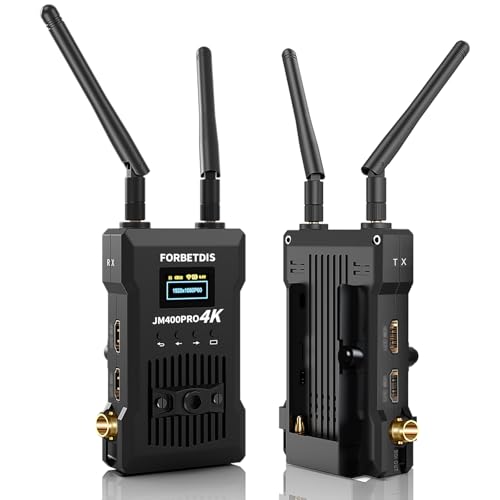
- Transmitter and receiver included
- 4K30 transmission with HDMI and SDI support
- Three power options, including NP-F batteries
Best For: Portable event, camera, and multi-display video setups
Best for Professional Monitoring

- 4K HDMI and 1080p 3G-SDI support
- Up to five monitoring destinations
- Camera control for selected Sony and Canon models
Best For: Professional film crews and multi-destination monitoring
Best Overall Flexibility
FEELWORLD WTRS Wireless Video System

- 4K/30fps transmission with SDI and HDMI connectivity
- Over 1,000 feet of range with approximately 80ms latency
- Built-in intercom, UVC streaming, and four-receiver support
Best For: Collaborative filmmaking and live production workflows
Best for Low Latency
Accsoon CineView SE Wireless Receiver

- Dual-band 2.4GHz and 5GHz transmission
- Up to 1,200 feet of range and 0.05-second latency
- HDMI and SDI support with app monitoring
Best For: Responsive 1080p on-set monitoring
Best for 4K Production
Hollyland Mars 4K Wireless System

- 4K/30fps HDMI transmission with SDI support
- Professional 23.98, 29.97, and 59.94 FPS SDI output
- Up to four app-monitoring options and flexible power
Best For: 4K crews using professional SDI equipment
Best Multi-Receiver SDI Pick – Hollyland Pyro S
The Hollyland Pyro S is a strong choice among wireless video receivers with SDI when you need HDMI and SDI connectivity, 4K monitoring, and multi-user viewing. Its 1,300-foot stated range, 50ms latency, and support for up to four receivers suit demanding production environments.
Best For: Film sets, live streaming, ENG/EFP work, and crews that need several simultaneous monitoring points.
Pros:
- HDMI and SDI input/output support, with HDMI transmission up to 4K30.
- Supports one transmitter sending to up to four receivers.
- Auto Dual-Band Hopping helps manage 2.4GHz and 5GHz interference.
- Includes UVC and RTMP-oriented streaming features plus advanced app monitoring tools.
Cons:
- The advertised 1,300-foot range depends on shooting conditions.
- SDI format support is focused on specified frame rates rather than 4K SDI.
Choose the Pyro S if SDI compatibility and flexible team monitoring matter more than a basic point-to-point setup. Its combination of 4K HDMI, SDI support, app tools, and receiver expansion makes it particularly adaptable for production workflows.
Best App-Friendly 4K SDI System – Accsoon CineView Master 4K Lite
The Accsoon CineView Master 4K Lite is a practical option among wireless video receivers with SDI for creators who want 4K HDMI transmission, 1080p SDI support, and mobile monitoring. It combines dual-band wireless transmission with USB-C video output and broad device compatibility.
Best For: Filmmakers, event crews, livestreamers, and users monitoring on Accsoon receivers or compatible mobile devices.
Pros:
- Supports up to 4K60 through HDMI and 1080p through 3G-SDI or HDMI.
- Can connect to up to five destinations: four wireless devices plus one wired USB-C connection.
- Quoted latency is under 35ms at 1080p60 and under 65ms at 4K60.
- Offers camera-control functions for listed Sony and Canon models.
Cons:
- USB-C video output is intended for supported mobile devices, not general computer UVC use.
- Some cables and receiving devices are sold separately.
The CineView Master 4K Lite stands out when mobile monitoring is part of the workflow. It provides useful 4K HDMI performance while retaining 1080p SDI compatibility, but buyers should verify device, cable, and camera-control compatibility before purchasing.
Best HDMI-Only Hollyland Option – Hollyland Pyro H
The Hollyland Pyro H is worth considering alongside wireless video receivers with SDI if your cameras and monitors use HDMI instead. It delivers 4K30 transmission, a 1,300-foot stated range, dual-band operation, and support for up to four receivers in a compact HDMI-focused system.
Best For: HDMI camera rigs, small film crews, live production, and plug-and-play computer streaming.
Pros:
- Supports HDMI video up to 3840×2160 at 24, 25, or 30fps.
- HDMI input, output, and loopout support flexible camera-to-monitor connections.
- Can transmit to up to four receivers and supports HollyView app monitoring.
- UVC support enables direct streaming to a computer without a capture card.
Cons:
- It does not provide SDI connectivity, so it is not suitable for SDI-native equipment.
- Its stated 60ms latency is higher than some alternatives in this roundup.
If your setup is entirely HDMI, the Pyro H offers a straightforward way to add wireless monitoring and streaming. However, buyers specifically seeking wireless video receivers with SDI should choose one of the SDI-equipped systems instead.
Best Long-Range SDI System – Accsoon CineView Master 4K
The Accsoon CineView Master 4K is a premium-looking choice among wireless video receivers with SDI, pairing 1080p SDI support with 4K60 HDMI transmission and tri-band wireless connectivity. Its stated 2.5km range and low latency are aimed at larger productions and demanding monitoring setups.
Best For: Professional film production, sports and event coverage, broadcast-style monitoring, and long-distance camera links.
Pros:
- Supports 4K60 through HDMI and 1080p through SDI or HDMI.
- Tri-band 2.4GHz, 5GHz, and 6GHz operation is designed for stable transmission.
- Quoted latency is below 25ms at 1080p and below 35ms at 4K.
- Supports up to four wireless devices plus wired iOS monitoring.
Cons:
- The 2.5km range is specified for an open, unobstructed environment.
- NP-F, DC, and V-Mount power accessories are not included.
- Its advanced capabilities may be more than needed for simple HDMI monitoring.
The CineView Master 4K is the strongest fit here for extended-range workflows that also need SDI compatibility and low delay. Its professional feature set is compelling, though the required power accessories and favorable range conditions should be included in the buying decision.
Best Multi-Receiver Pick – Hollyland Pyro S RX
For productions that need wireless video receivers with SDI, the Hollyland Pyro S RX combines HDMI and SDI connectivity with 4K30 support over HDMI, a claimed 1,300-foot range, and 50ms latency. Its receiver-only design is especially useful when expanding an existing Pyro setup or building a multi-monitor workflow.
Best For: Film sets, live streams, ENG/EFP work, and teams monitoring one transmitter on multiple displays.
Pros:
- Supports HDMI and SDI input/output connections with broad format compatibility.
- Handles up to 4K30 via HDMI and offers a claimed 1,300-foot transmission range.
- Supports one transmitter to up to four receivers and includes app monitoring tools such as waveform and vectorscope.
- UVC plug-and-play streaming and RTMP support add flexible live-production options.
Cons:
- This listing is for the receiver only, so a compatible transmitter is required.
- The product weighs 2.2 pounds, which may be more than some compact monitoring setups need.
The Pyro S RX is a strong choice when scalable monitoring and professional HDMI/SDI integration matter more than having a complete transmitter-receiver kit in the box.
Best Complete Kit – JM400PRO Wireless SDI/HDMI System
The JM400PRO is a practical two-piece option for buyers seeking wireless video receivers with SDI in a ready-to-use transmitter-and-receiver kit. It supports up to 4K30 transmission, HDMI and SDI connections, a claimed 985-foot range, and multiple power methods for mobile production.
Best For: Videographers, event teams, and filmmakers who need to send camera video to multiple HDMI or SDI displays.
Pros:
- Includes both transmitter and receiver, with support for 4K30 video transmission.
- Receiver offers dual HDMI output and SDI output, while the transmitter includes HDMI/SDI input and HDMI loop-out.
- Supports one transmitter to up to four receivers for multi-screen monitoring.
- Offers USB-C, 9–16V DC, and NP-F battery power options.
Cons:
- The stated 985-foot range is measured in open conditions, and adding receivers can reduce transmission distance.
- Real-time gaming may experience the listed 0.06-second delay.
- Batteries are not included.
With flexible power and useful output options, the JM400PRO is well suited to portable HDMI/SDI distribution where a complete kit is more convenient than purchasing a receiver separately.
Best for Professional Monitoring – Accsoon CineView SE 4K
The Accsoon CineView SE 4K is designed for professional crews comparing wireless video receivers with SDI and advanced monitoring features. It supports 4K formats through HDMI, 1080p through 3G-SDI/HDMI, a claimed 1,312-foot range, and low latency down to 0.05 seconds at 1080p.
Best For: Filmmakers, directors, cinematographers, and production teams needing multi-destination monitoring and compatible camera control.
Pros:
- Supports 4K30 input/output through HDMI and 1080p through 3G-SDI/HDMI.
- Offers a claimed 1,312-foot range and 0.05-second latency at 1080p.
- Can connect one transmitter to up to five monitoring destinations, including one wired USB-C connection.
- Supports selected Sony and Canon camera-control functions through compatible wired or direct Wi-Fi connections.
Cons:
- USB-C video output is for compatible mobile monitoring only and does not support UVC computer capture.
- Mac and PC computers are not supported for the listed monitoring connections.
- 4K latency is listed at 0.1 seconds, higher than the 1080p figure.
The CineView SE 4K stands out for crew monitoring and camera-control workflows, but buyers should verify device compatibility and remember that its USB-C output is not a general-purpose webcam connection.
Best Overall Flexibility – FEELWORLD WTRS Wireless Video System
For filmmakers seeking wireless video receivers with SDI, the FEELWORLD WTRS stands out for its combination of 4K support, SDI and HDMI connectivity, and practical production features. It can transmit over 1,000 feet with approximately 80ms latency while also supporting app monitoring and UVC streaming.
Best For: Multi-camera productions, crews needing intercom communication, and users who want direct computer streaming without a capture card.
Pros:
- Supports 4K/30fps video transmission with SDI and HDMI options.
- Offers more than 1,000 feet of stated transmission range and low latency.
- Includes built-in intercom, UVC output, smart channel scanning, and support for up to four receivers.
Cons:
- The Android app currently supports monitoring while some advanced functions remain in development.
- At 80ms latency, it is not the lowest-latency option in this roundup.
The WTRS is a versatile choice when connectivity and workflow features matter as much as image quality. Its flexible outputs and built-in intercom make it especially useful for collaborative shoots and live production setups.
Best for Low Latency – Accsoon CineView SE Wireless Receiver
The Accsoon CineView SE is a strong option for buyers comparing wireless video receivers with SDI and prioritizing responsive monitoring. Its dual-band 2.4GHz and 5GHz transmission combines streams for improved stability, while the system supports 1080p at up to 60fps with claimed 0.05-second latency.
Best For: HD productions that need fast monitoring, extended range, and wireless viewing on multiple devices.
Pros:
- Uses simultaneous 2.4GHz and 5GHz transmission to help manage interference.
- Claims up to 1,200 feet of range and approximately 0.05-second latency.
- Supports HDMI and SDI connections, plus app-based monitoring through Accsoon GO.
Cons:
- This listing is for the receiver only, so a compatible transmitter is required.
- Video support is listed at 1080p up to 60fps rather than 4K.
Choose the CineView SE when smooth, responsive HD monitoring is more important than 4K resolution. Its compact aluminum construction, silent cooling, and dual-band design suit demanding on-set monitoring environments.
Best for 4K Production – Hollyland Mars 4K Wireless System
The Hollyland Mars 4K is designed for productions that need wireless video receivers with SDI alongside 4K HDMI capability. It supports 4K video at up to 30fps, HD SDI output with professional decimal-point frame rates, and monitoring through both the included receiver and mobile apps.
Best For: Professional crews using 4K cameras, SDI equipment, and multiple director or producer monitoring points.
Pros:
- Supports 4K HDMI transmission up to 30fps and SDI output for professional workflows.
- Handles 23.98, 29.97, and 59.94 FPS SDI output formats.
- Offers up to four app-monitoring options and multiple power methods.
Cons:
- Its stated 450-foot line-of-sight range is shorter than some competing systems.
- Claimed latency is approximately 66ms, rather than the lowest figure in this group.
- USB-C QC/PD charging is not supported.
The Mars 4K is a sensible fit for crews that need both 4K HDMI and production-friendly SDI frame-rate support. Its LCD screen, joystick controls, and flexible power options also make field setup easier.
How We Picked These Wireless Video Receivers with Sdi
We focused on systems that include SDI connectivity on the transmitter, receiver, or both, while also considering HDMI compatibility for cameras, monitors, and consumer video equipment. We compared stated resolution and frame-rate support, transmission range, latency, wireless-band design, receiver expansion, app monitoring, and practical production features such as frequency management and camera control.
Advertised range is measured under favorable conditions, so real-world performance can be lower around walls, people, Wi-Fi congestion, and other radio equipment. We treated range and latency claims as useful comparison points rather than guarantees.
Quick Comparison
- Best for flexible professional workflows: Look for HDMI and SDI on both ends, broad frame-rate support, and dependable frequency selection.
- Best for multi-viewer setups: Choose a system that supports several receivers or app-connected devices at once.
- Best for long-distance production: Prioritize strong line-of-sight range, dual- or tri-band operation, and reliable interference management.
- Best for mobile crews: Favor compact hardware, USB-C or battery power options, and a quick pairing process.
Key Buying Factors for Wireless Video Receivers with Sdi
SDI Format and Resolution Support
Confirm that the unit supports your camera’s exact SDI standard, resolution, and frame rate. A receiver advertised as 4K may not accept every 4K frame rate, and some systems handle 4K input while limiting wireless output or monitoring to another format. Also check support for fractional rates such as 23.98, 29.97, and 59.94 when working in broadcast or cinema environments.
Latency, Range, and Reliability
Lower latency matters for focus pulling, live switching, and camera operation. Range matters most when the receiver must remain far from the camera, but a stable signal is more valuable than a long theoretical distance. Dual-band or tri-band systems can offer more flexibility in crowded locations, while clear line of sight remains important.
Receiver Count and Outputs
If multiple people need the feed, check how many receivers or mobile devices can connect simultaneously. Verify whether each receiver provides SDI, HDMI, or both, and whether outputs remain active at the same resolution and frame rate.
Power and Physical Setup
Check battery compatibility, mounting points, power input, antenna design, and cable access. A compact receiver may be ideal for a camera cart or gimbal, while a larger unit with robust connectors may be better for a control room or live-event rack.
Who Should Buy Which Wireless Video Receivers with Sdi?
Film and commercial crews should prioritize low latency, 4K support, SDI output, and dependable interference handling. Live-event and broadcast users should focus on compatible SDI frame rates, long line-of-sight range, stable frequency management, and rugged connections. Small production teams may get more value from systems that support multiple receivers or phone and tablet monitoring. Budget-conscious creators should choose a model with the required SDI format and range rather than paying extra for resolution or features their cameras cannot use.