Small bands need MIDI gear that solves real setup problems without adding unnecessary complexity. The right interface can connect keyboards, controllers, computers, and hardware instruments while keeping your rehearsal or recording rig manageable.
This roundup includes dedicated MIDI hosts, wireless adapters, USB-to-MIDI cables, and audio interfaces with MIDI-friendly workflows, so you can match the connection type to your band’s equipment and budget.
Best 10 Midi Interfaces for Small Bands Picks for 2026
Flexible Recording Hub

- Two combo inputs plus MIDI I/O
- 32-bit/192kHz USB-C audio
- DSP monitoring and rugged metal housing
Best For: Small bands recording vocals, instruments, and MIDI gear
Computer-Free MIDI Bridge

- USB MIDI to 5-pin DIN conversion
- Standalone operation without a computer
- LED power and MIDI activity indicators
Best For: Live and rehearsal rigs using USB controllers and DIN MIDI hardware
Simple Vocal-and-Instrument Interface
Focusrite Scarlett Solo 3rd Gen

- One mic input and one Hi-Z instrument input
- 24-bit/192kHz recording with Air mode
- Includes recording software and plug-ins
Best For: Overdubbing vocals, guitar, or bass in a compact setup
Wireless Performance Link
Low-Latency Wireless MIDI Adapter

- Point-to-point wireless MIDI connection
- Approximately 3ms stated latency
- Rechargeable and USB-powered operation
Best For: Cable-free MIDI practice, teaching, and live performance
Best Compact Audio Interface
- Two-channel USB recording
- XLR, line, and instrument inputs
- Direct monitoring with included software
Best For: Small-band demos and basic streaming
Best Wireless Beat Controller

- Bluetooth and USB MIDI
- 16 RGB pads with aftertouch
- Up to 15-hour rechargeable battery
Best For: Live sample triggering and mobile beat making
Best USB-to-DIN MIDI Bridge

- One USB MIDI in and one MIDI out
- Supports 16 MIDI channels and SysEx
- Activity LEDs and firmware updates
Best For: Connecting USB MIDI gear to five-pin hardware
Wireless Freedom

- Below-3ms advertised latency
- Automatic pairing with standard 5-pin MIDI
- Up to 25 hours of rechargeable use
Best For: Wireless performance and rehearsal setups
Compact Connectivity
Midiplus 2x2 USB MIDI Interface

- Two MIDI inputs and two MIDI outputs
- USB-powered with no external supply
- Driver-free support for Mac and Windows
Best For: Computer-based small-band MIDI setups
Simple Computer Link
- MIDI In and Out with LED indicators
- Supports 16 channels in and 16 out
- 2-meter cable for computer connections
Best For: Single-keyboard recording and overdubbing
Flexible Recording Hub – Yamaha URX22C
For small bands comparing midi interfaces for small bands, the Yamaha URX22C combines two combo inputs, MIDI I/O, and USB-C connectivity in a durable, compact interface. Its DSP monitoring and included software make it suitable for rehearsals, demos, and home recording.
Best For: Small bands needing two mic/instrument inputs plus traditional MIDI connectivity.
Pros:
- Two XLR/TRS combo inputs with Class-A D-PRE preamps and +48V phantom power
- Includes MIDI I/O, Hi-Z input, and two TRS main outputs
- Supports up to 32-bit/192kHz audio and latency-free DSP monitoring
- Rugged full-metal housing with cross-platform Windows, macOS, and iOS support
Cons:
- Only provides two analog inputs for larger live-band setups
- Its advanced DSP features may be more than a simple recording setup requires
The URX22C is the most complete traditional interface here for a small band that needs both audio recording and hardware MIDI. The two-input design keeps it portable, while DSP effects and bundled Steinberg software add useful recording flexibility.
Computer-Free MIDI Bridge – DigitalLife BridgeCore
For bands building a hardware-based setup, the DigitalLife BridgeCore is a focused choice among midi interfaces for small bands. It connects USB MIDI keyboards and controllers to 5-pin DIN MIDI hardware without a computer, making it useful for rehearsals, live rigs, and standalone synth setups.
Best For: Performers connecting a USB MIDI controller to traditional 5-pin DIN equipment without a computer.
Pros:
- Converts USB MIDI data to standard 5-pin DIN MIDI output
- Standalone plug-and-play operation with no computer required
- LED indicators show power and MIDI activity
- Compact metal housing and support for many class-compliant USB MIDI devices
Cons:
- Does not function as a computer MIDI interface
- USB hubs are not supported
- Compatibility may vary with devices using non-standard MIDI protocols
The BridgeCore solves a specific connection problem rather than replacing a full audio interface. Choose it when a small band needs to integrate modern USB controllers with older DIN-equipped synthesizers, modules, or other MIDI hardware.
Simple Vocal-and-Instrument Interface – Focusrite Scarlett Solo 3rd Gen
For small bands seeking an approachable starting point, the Focusrite Scarlett Solo is a practical option among midi interfaces for small bands, although the supplied model is primarily an audio interface rather than a traditional MIDI I/O unit. It offers one mic input, one Hi-Z instrument input, and bundled recording software.
Best For: Solo or small-band demos focused on recording one microphone and one guitar or bass at a time.
Pros:
- One XLR mic preamp and one Hi-Z instrument input
- 24-bit/192kHz recording with low-noise balanced outputs
- Air mode can add clarity to acoustic instruments
- Includes Pro Tools Intro+, Ableton Live Lite, Cubase LE, and Hitmaker Expansion
Cons:
- Only one microphone input limits simultaneous band recording
- The supplied notes do not list dedicated MIDI input or output
- Two-input layout is better suited to overdubbing than full-band capture
The Scarlett Solo is a strong budget-friendly recording foundation for overdubs, vocals, guitar, or bass. If your band specifically needs DIN MIDI connections, however, a dedicated MIDI interface or the Yamaha model will be a better fit.
Wireless Performance Link – Low-Latency Wireless MIDI Adapter
When cable-free movement matters, this wireless adapter offers a different approach to midi interfaces for small bands. It is designed for point-to-point MIDI connections in practice, teaching, and performance settings, with a stated latency of about 3 milliseconds and rechargeable power for one adapter.
Best For: Musicians who want a wireless MIDI link between compatible devices for practice or live performance.
Pros:
- Eliminates the need for a direct MIDI cable between connected devices
- Designed for low-latency transmission with approximately 3ms delay
- Supports common DAW and MIDI software across several operating systems
- Rechargeable lithium battery included in MIDI A, with USB power options
Cons:
- Designed for point-to-point connections rather than a multi-device MIDI hub
- Wireless compatibility depends on the connected devices and software
- It does not provide audio inputs or outputs
This adapter is best viewed as a mobility accessory, not a replacement for a USB audio/MIDI interface. It can reduce cable clutter around a keyboard or controller, while bands recording microphones or instruments will still need a separate audio interface.
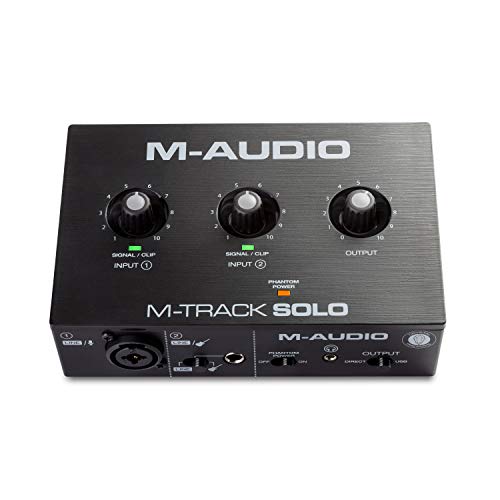
Best Compact Audio Interface – M-Audio M-Track Solo
For small bands looking at midi interfaces for small bands alongside recording gear, the M-Audio M-Track Solo is a compact USB audio interface for capturing vocals, guitar, and line-level sources. Its two-channel design, phantom-powered combo input, and direct monitoring make it a practical choice for basic rehearsals, demos, streaming, and home recording.
Best For: Small-band demos, solo performers, podcasts, and simple live-streaming setups.
Pros:
- Two-channel interface with XLR, line, and instrument connectivity.
- Phantom power and a Crystal Preamp support condenser microphones.
- USB/direct monitoring switch helps provide zero-latency monitoring.
- Includes MPC Beats and supports Ableton Live Lite.
Cons:
- Maximum sample rate is 48 kHz.
- Its two-channel layout may be limiting for larger band recordings.
- It provides RCA outputs rather than a broader range of studio connections.
The M-Track Solo suits bands that need a small, straightforward recording interface rather than a full multi-microphone rig. It is especially useful when portability and simple monitoring matter more than extensive I/O.
Best Wireless Beat Controller – Mini 16-Pad MIDI Controller
For bands exploring midi interfaces for small bands, this compact pad controller adds wireless MIDI control for beats, samples, effects, and loops. Bluetooth and USB connectivity, a rechargeable battery rated for up to 15 hours, and customizable pad mappings make it suitable for mobile production and live performance.
Best For: Small bands adding sampled parts, loops, or beat-triggered effects to rehearsals and performances.
Pros:
- Offers both Bluetooth MIDI and USB MIDI connectivity.
- Includes 16 RGB velocity-sensitive pads with aftertouch.
- Up to 15 hours of battery life supports extended mobile sessions.
- Pad mappings, MIDI commands, velocity curves, and lighting are customizable.
Cons:
- It is a pad controller, not an audio interface or conventional 5-pin MIDI converter.
- Its compact 16-pad layout may provide less control than a larger controller.
- Wireless use depends on compatible Bluetooth MIDI devices and software.
This controller is a flexible addition for bands using computers, tablets, or mobile devices to trigger samples and loops. Its portable design favors expressive performance and quick setup, while the app and PC customization options allow it to fit different DAW workflows.
Best USB-to-DIN MIDI Bridge – UMH-21 MIDI Host Interface
For midi interfaces for small bands that need to connect modern USB MIDI gear with traditional hardware, the UMH-21 provides one MIDI input and one MIDI output. It converts a USB MIDI device connection to standard five-pin MIDI, supports 16 MIDI channels and SysEx commands, and includes activity indicators for easier troubleshooting.
Best For: Small bands linking USB MIDI controllers or instruments with standard five-pin MIDI equipment.
Pros:
- Provides one-in/one-out USB-to-standard five-pin MIDI connection.
- Supports USB 2.0, USB 1.0, and USB 1.1 MIDI devices.
- Handles standard 16-channel MIDI and SysEx commands.
- LED indicators show power, USB activity, and MIDI input/output activity.
Cons:
- It offers one MIDI input and one MIDI output rather than multiple ports.
- It is a MIDI interface, not an audio recording interface.
- No specific DAW software is included or identified in the supplied details.
The UMH-21 is useful when a small band’s setup mixes USB MIDI devices with older keyboards, modules, or other DIN-MIDI hardware. Its firmware-update support and visible status LEDs add practical flexibility, though its single-port design is best for focused connections.
Wireless Freedom – SK7 MIDI Wireless Adapter
For small bands seeking flexible midi interfaces for small bands, the SK7 Wireless Adapter is a convenient option for compatible standard 5-pin MIDI equipment. Its automatic pairing, rechargeable battery, and transmitter/receiver operation are designed to simplify setup for rehearsals, performances, and recording sessions.
Best For: Performers and small studio setups that want wireless connections for standard 5-pin MIDI devices.
Pros:
- Advertised latency below 3ms for responsive performance.
- Automatic pairing and plug-and-play operation without drivers.
- Up to 25 hours of rechargeable-battery use.
- Can function as either a MIDI transmitter or receiver.
Cons:
- Requires standard 5-pin MIDI connections.
- Wireless operation adds battery charging to your setup routine.
The SK7 stands out when reducing cable clutter matters more than adding multiple wired ports. Its long stated battery life and flexible two-way operation make it especially practical for mobile band setups.
Compact Connectivity – Midiplus 2×2 USB MIDI Interface
The Midiplus 2×2 is a straightforward choice among midi interfaces for small bands that need more than one MIDI input and output. USB power, driver-free operation on Mac and Windows, and two-by-two MIDI connectivity make it suitable for computer-based recording and control.
Best For: Small bands or home studios connecting two MIDI inputs and two MIDI outputs to a computer.
Pros:
- Provides two MIDI inputs and two MIDI outputs.
- USB-powered, so no external power supply is required.
- Works with Mac OS X and Windows XP or newer without a driver.
- Compatible with default and other MIDI software on supported computers.
Cons:
- Designed for MIDI connectivity rather than audio input or output.
- Requires a computer and USB connection for power and operation.
With two inputs and two outputs, the Midiplus offers a useful step up from a single-cable adapter without becoming overly complex. It is a practical wired hub for computer-centered band arrangements.
Simple Computer Link – TENINYU USB MIDI Cable
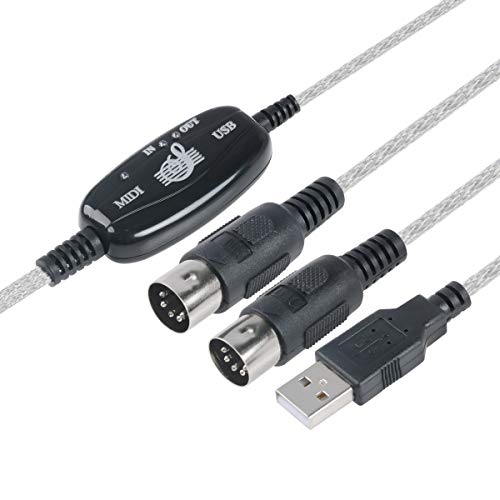
The TENINYU USB to MIDI cable is a budget-friendly, cable-based option for midi interfaces for small bands that primarily need to connect one keyboard or synthesizer to a computer. It includes MIDI In and Out leads, LED status indicators, and a 2-meter cable for a flexible desktop setup.
Best For: Musicians connecting a single MIDI keyboard or synthesizer to a Windows or Mac computer for recording and editing.
Pros:
- Supports up to 16 MIDI channels in and 16 out.
- Includes MIDI In and Out connections with LED activity indicators.
- Works with listed Windows versions and Mac OS.
- Offers a 2-meter cable length for convenient placement.
Cons:
- Some setups require both MIDI plugs to be connected.
- Does not support hot-swapping.
- iOS use requires an authentic Camera Connection Kit and may not work otherwise.
The TENINYU is best viewed as a focused single-device computer link rather than a multi-port band interface. Its long cable and status lights can make basic recording and overdubbing easier, provided the connection procedure is followed.
How We Picked These Midi Interfaces for Small Bands
We focused on practical connectivity, portability, compatibility, and ease of use. The selection covers several common setups: computer-based recording, hardware keyboards and synthesizers, wireless connections, and systems that need a standalone USB host. We also considered channel support, connector types, power requirements, latency expectations, and whether each product is best suited to rehearsal, studio, or live performance.
Because “MIDI interface” can describe several different products, check the product type carefully. Some models transfer MIDI only, while others are full audio interfaces that add microphone and instrument inputs. A USB-to-MIDI cable is useful for a single device, but it offers less flexibility than a 2×2 interface or host box.
Quick Comparison
| Type | Best For | Main Advantage | Watch For |
|---|---|---|---|
| 2×2 USB MIDI interface | Multiple hardware instruments | Separate MIDI inputs and outputs | Requires a computer or compatible host |
| USB MIDI host | Connecting USB controllers to MIDI gear | Standalone operation | Power and device compatibility |
| Wireless MIDI adapter | Reduced cable clutter | Convenient device-to-device links | Pairing and latency variables |
| USB-to-MIDI cable | One keyboard or synth | Low cost and simple setup | Limited expansion |
| Audio interface | Recording vocals, instruments, and MIDI workflows | Audio inputs plus computer connectivity | May not provide traditional 5-pin MIDI ports |
Key Buying Factors for Midi Interfaces for Small Bands
Connections and Device Count
List every device you need to connect: keyboards, drum machines, controllers, synth modules, and the band computer. A 1-in/1-out solution works for a single MIDI chain, while a 2×2 interface provides more routing flexibility. If your controller uses USB but your instrument uses 5-pin DIN, choose a USB host or an interface specifically designed to bridge those formats.
Computer Dependence
Some units need a computer to translate or route MIDI, while standalone hosts can work without one. For rehearsals and live sets, standalone operation may be more dependable. For recording, a USB interface with stable driver support and broad operating-system compatibility can be the better choice.
Wireless Performance and Power
Wireless MIDI can simplify stage layouts, but pairing, battery life, range, and interference matter. Use wired connections for mission-critical timing when possible, and test wireless adapters with every device before a performance.
Audio Needs and Latency
If the band also records microphones or instruments, an audio interface may deliver better overall value than a MIDI-only adapter. Look for suitable input counts, monitoring controls, dependable USB connectivity, and low-latency operation. MIDI itself uses modest bandwidth, but poor drivers, overloaded computers, or wireless links can still create timing issues.
Who Should Buy Which Midi Interfaces for Small Bands?
Choose a USB-to-MIDI cable if you need the simplest connection between one computer and one keyboard or synthesizer. Pick a 2×2 MIDI interface when the band uses several pieces of hardware and needs independent inputs and outputs. A standalone USB host is the better choice for connecting USB controllers to traditional MIDI equipment without keeping a computer onstage.
Wireless adapters suit compact rigs and performers who value fewer cables, provided the pairing process and latency meet your needs. Finally, choose a full audio interface if your small band needs to record microphones or instruments alongside computer-based MIDI production. Before buying, verify connector formats, power requirements, operating-system support, and whether the included cables match your equipment.